
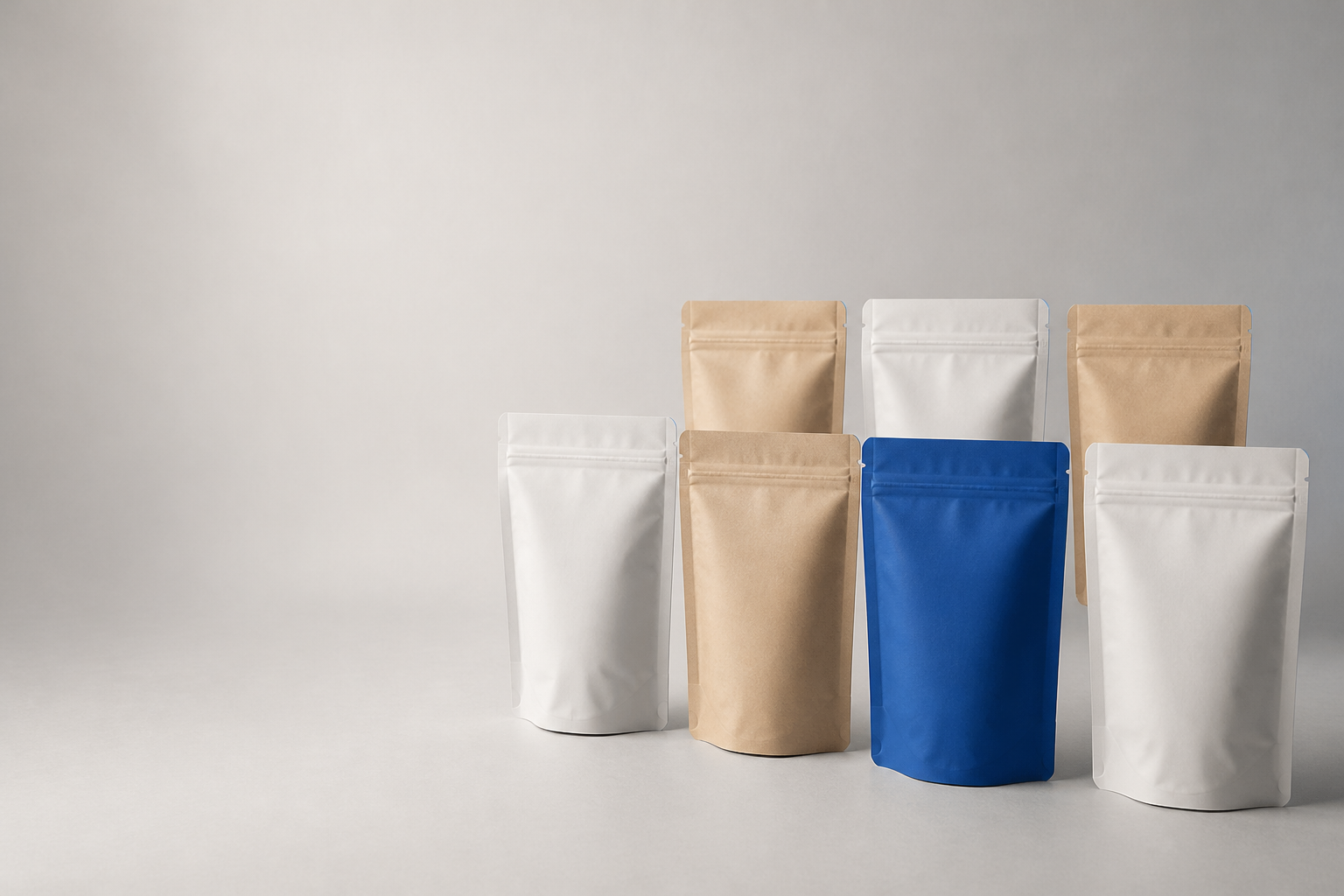
If you sell packaged goods into the European Union, the rulebook changed on 12 August 2026. Regulation (EU) 2025/40 — the Packaging and Packaging Waste Regulation (PPWR) — now applies across the EU, replacing the old Packaging Directive 94/62/EC.
For brands buying stand up pouches, flat bottom bags, roll film or printed mylar bags, PPWR is not a labelling exercise. It reaches into film structure, which is the one decision that locks in your packaging's recyclability for years. This article covers what the regulation requires, which of those requirements hit flexible packaging hardest, and what to specify now so a pouch you approve today does not become a redesign in 2029.
1. The dates that matter for pouch packaging
PPWR has many deadlines. These are the ones a flexible packaging buyer should actually diarise:
| Date | What happens |
|---|---|
| 11 Aug 2026 / 12 Aug 2026 | Regulation applies; PFAS restrictions on food-contact packaging begin; conformity assessment obligations apply |
| 12 Aug 2028 at the earliest | Harmonised material-composition labelling (Article 12) becomes mandatory — or 24 months after the implementing act, whichever is later |
| 1 Jan 2030 | Packaging must be recyclable at Grade C or above; first recycled content targets begin; packaging minimisation and empty-space rules apply |
| 1 Jan 2038 | Only Grade A and Grade B packaging may be placed on the market |
The Article 6 delegated act that sets the detailed design-for-recycling criteria and the grading methodology is due 1 January 2028. Until it lands, grades are assessed against Annex II, but the exact calculation method is still being finalised — which is why the practical advice today is to design toward mono-material, not to wait for the final text.
2. Recyclability grades: A, B, C — and what "below C" costs you
PPWR expresses recyclability as the share of the packaging unit, by weight, that can be recycled in existing EU infrastructure. Annex II defines the bands:
| Grade | Share of unit recyclable | Position |
|---|---|---|
| A | ≥ 95% | Best; lowest eco-modulated EPR fees |
| B | ≥ 80% | Acceptable through 2037 |
| C | ≥ 70% | Sellable through 2037; drops out on 1 Jan 2038 |
| Below C | < 70% | Cannot be placed on the EU market from 1 Jan 2030 |
Two consequences matter commercially:
- Grade becomes a cost line. EPR fees are eco-modulated by grade under Article 45 — better grades pay less. A pouch that is cheap per unit today can be more expensive per unit once national EPR schemes apply grade-linked fees.
- Below Grade C is a hard stop, not a penalty. From 2030, packaging under 70% recyclable cannot go on the market at all. It has to be redesigned or withdrawn.
3. Why multi-material laminates are the crux for pouches
This is where flexible packaging sits closest to the fire.
A traditional high-barrier pouch is a laminate — several materials bonded together, each doing a job:
- PET / AL / PE — outstanding oxygen and moisture barrier; the classic coffee and protein powder structure
- PET / VMPET / PE — the mid-market workhorse for snacks and nuts
- Kraft paper / AL / PE — the "natural look" structure for artisan and eco-positioned brands
- PET / PE (clear) — display and sample formats with moderate barrier
Each of those structures is excellent at keeping product fresh. The problem PPWR creates is that layers bonded together are hard to separate, and EU sorting and recycling infrastructure is built mainly around single-material streams. A pouch that cannot be sorted into a recycling stream scores poorly against Annex II — and the aluminium or metallised layer, which is exactly what delivers the barrier, is also what pushes the weight-based recyclability share down.
The direction of travel is toward mono-material structures — typically all-PE or all-PP constructions that can be recycled in existing polyolefin streams. They carry a trade-off: barrier performance usually has to be rebuilt through sealant choice, coating or metering rather than by dropping in aluminium foil. For coffee, that trade-off is hard. For snacks, dried fruit, pet treats and household goods, it is often very achievable.
Practical implication for buyers: the pouch structure you specify now should be chosen with the 2030 threshold in mind. Ask for the recyclability assessment at the sampling stage, when changing structure costs you a sample rather than a print run.
Mono-material structures: where to start
ME Packs produces mono-material pouches in both PE and PP for brands designing toward the PPWR thresholds. A mono-material pouch scores better for a structural reason, not a marketing one: because no dissimilar layers are bonded together, the unit does not depend on separation technology that EU sorting facilities are not built around. The recoverable share of unit weight goes up simply because there is less of the package that has to be discarded.
PE and PP each belong to a single polymer family, so the pouch enters one material stream rather than needing a de-lamination step first. Which of the two suits your product is a technical decision, not a preference:
- PP tolerates higher fill temperatures and gives a stiffer, glossier pack — usually the better fit for hot-filled formats and for brands wanting a premium shelf appearance.
- PE is generally the more forgiving sealant and the softer, more flexible option — often the easier starting point for powder, snack and household formats that need a clean seal at running speed.
We quote both where the product allows it, so you can compare barrier performance, seal strength and pack appearance side by side before committing to a print run.
Whether mono-material is viable for you depends on your barrier requirement, and the honest answer varies by product:
- Moisture-only protection (dried fruit, powders, confectionery, many household goods) migrates to mono-material most easily.
- Oxygen-sensitive products (coffee, nuts, some supplements and pet foods) need the barrier rebuilt rather than dropped — through sealant selection, coating or metering instead of a foil layer.
- Grease-resistant formats (snack and pet food) have the additional PFAS question from Article 5, which has to be solved at the same time as the structure.
That is why we assess mono-material per product, not per category. If you have a multi-material structure selling in the EU today, send the product type and target shelf life: we will tell you whether a mono-material alternative holds, and what the trade-off would be.
4. PFAS: the restriction that hits snack and pet food packaging first
From 12 August 2026, PPWR restricts PFAS — per- and polyfluoroalkyl substances — in food-contact packaging. PFAS are the "forever chemicals" that have historically been used in grease-resistant and moisture-resistant coatings.
The Article 5 limit values are specific:
- Each individual PFAS < 25 ppb
- Sum of PFAS, excluding polymeric PFAS, < 250 ppb
- Sum of PFAS, including polymeric PFAS, < 50 ppm
- Where total fluorine exceeds 50 ppm, technical documentation proving PFAS or non-PFAS content is required
If your packaging uses a grease barrier — snack bags, pet food, fast-food wraps, bakery — PFAS is the first thing to audit. Suppliers are expected to provide non-detection certificates. PFAS-free alternatives exist (silicone, plant-based and alternative coating chemistries), but they need to be tested against your actual product, not assumed to perform identically.
The same article also confirms the long-standing heavy metals limit: the combined concentration of lead, cadmium, mercury and hexavalent chromium in packaging or its components must not exceed 100 mg/kg.
5. Recycled content: starting 1 January 2030
Article 7 sets minimum post-consumer recycled (PCR) content for the plastic parts of packaging. For flexible packaging the relevant rows are:
| Packaging type | 2030 | 2040 |
|---|---|---|
| Contact-sensitive, PET as major component | ≥ 30% | ≥ 50% |
| Contact-sensitive, non-PET plastics | ≥ 10% | ≥ 25% |
| Other packaging | ≥ 35% | ≥ 65% |
Most flexible pouches fall into the contact-sensitive non-PET row — so the figure to plan against is 10% PCR by 2030, rising to 25% by 2040. The Commission is to set the calculation and verification methodology by 31 December 2026, which means mass-balance tracking and supplier documentation will become standard paperwork between buyer and converter.
The practical question to ask now is not "can you supply PCR?" but "which of my structures can carry PCR film without losing seal integrity or food-contact clearance?" Those are two different tests, and the second one is the one that fails late.
6. Labelling, conformity and EPR paperwork
Three administrative obligations arrive alongside the technical ones.
Harmonised labelling (Article 12). Packaging must carry a harmonised material-composition label, with sorting information reachable through a data carrier such as a QR code. Timing is 12 August 2028 at the earliest, or 24 months after the implementing act — and the Article 12(6) implementing act was due on 12 August 2026 but had not been adopted. Practical advice: assemble the composition and sorting data your label will need, but do not fix your artwork around a data-carrier format yet.
Declaration of Conformity (DoC). Under Article 39 and Annex VIII, a DoC must be drawn up for each packaging type, backed by technical documentation — packaging description, materials, drawings, applicable standards, and how the Articles 6, 10 and 11 assessments were carried out, plus test reports. Records are kept for 5 years (single-use) or 10 years (reusable). You will need one from each packaging supplier, consolidated in one place.
EPR registration. Producers register in every Member State where they place packaging on the market, report volumes by material type, and pay fees. Because the EU EPR framework is implemented nationally, registration and reporting requirements vary country by country.
7. What to ask your pouch supplier
If you are buying flexible packaging for the EU market, these are the questions that separate a supplier who has read the regulation from one who has read the headline:
- What is the recyclability assessment of this structure, and which grade band does it fall into under Annex II?
- Which parts of the structure are separable, and what share of unit weight is recyclable in EU infrastructure?
- Does the structure contain PFAS at any layer — coating, sealant or ink — and can you provide a non-detection certificate?
- Can this structure carry PCR film while holding food-contact clearance and seal strength?
- Will you provide a Declaration of Conformity for this packaging type, with supporting documentation and test reports?
- What is the mono-material alternative, and what barrier performance would I give up to get it?
A supplier who can answer 1, 3 and 5 in writing is one you can put in front of an EU importer or retailer without a scramble later.
8. A realistic migration path
Most brands cannot rebuild every SKU at once. A workable sequence:
- Audit every SKU: material structure, layers, weights, current barrier requirement.
- Triage by risk — PFAS-containing grease barriers and heavy laminates first, low-barrier display formats last.
- Re-specify the highest-risk SKUs toward mono-material, and validate barrier through shelf-life testing rather than assumption.
- Re-sample rather than re-print — structure changes should be proven at sample stage.
- Collect documentation as you go: DoCs, PFAS certificates, PCR evidence, recyclability assessments. Retrofitting this paperwork in 2029 is the expensive path.
None of this requires finalising the Article 6 methodology. Designing toward separable, weight-efficient structures is the right move under every version of the text still on the table.
The short version
PPWR is already live. The recyclability thresholds bite in 2030, PFAS restrictions on food contact are in force now, and the paperwork — DoCs, EPR registration, labelling data — is cumulative. For flexible packaging, the structural decision is the one that decides everything downstream: how many materials are bonded together, and how much of the unit weight can be recovered.
The brands that will find the 2028–2030 deadlines uneventful are the ones asking about structure and documentation at the sampling stage today.
ME Packs manufactures custom printed mylar bags, stand up pouches and flat bottom bags for food, snack, pet and supplement brands — including mono-material PE and PP structures for brands designing toward the PPWR recyclability thresholds — with low MOQ from 1 pc and 7-day production. If you need a structure assessed against PPWR before you commit to a run, send your product type and target shelf life to info@mepacks.com with "PPWR" in the subject line: we will come back with the mono-material and multi-material options side by side, plus the documentation we can supply.