
What flour, sugar, salt, feed and seed have in common
On a spec sheet these are five unrelated products. In a filling line they share the same three failure modes, and all three are packaging problems:
- Caking — moisture ingress makes fine powders clump and sets off microbial growth.
- Dust — fine particles escape through seams and closures, and dust is where insects and spoilage start.
- Seal contamination — powder in the seal area is the single most common cause of a leak that tests fine in the lab and fails in the pallet.
Everything below is a variation on managing those three.
Flour bags
Flour is the classic fine-powder case. Two structures dominate:
- Multiwall kraft paper — traditional, breathable, good print, and cheap per bag. It is also not robust: paper bags generally only make sense for smaller retail weights, because they do not carry heavy loads well.
- Woven PP, laminated — the workhorse for larger weights. The lamination keeps external humidity out and stops fine flour escaping through the weave. Where flour is going into humid climates or long storage, the lamination is not optional.
If your flour is retail-packaged for supermarket shelves, the smaller formats — flat bottom bags and stand up pouches — give you a printable front panel and a resealable closure, and both handle fine powder better than a stitched sack.
Sugar bags
Sugar presents the opposite problem to flour: it is crystalline, free-flowing, and hygroscopic. Absorbed moisture makes it sticky and eventually a solid block.
Because sugar is dense, a given fill weight needs a smaller bag than flour — which is why sugar sacks often look deceptively compact. Two practical notes:
- Lamination matters more than thickness. A laminated woven bag resists humidity far better than a thicker unlaminated one.
- Closure choice drives shelf life. For retail, a heat-sealed film structure outperforms a stitched sack where humidity is a risk.
Salt bags
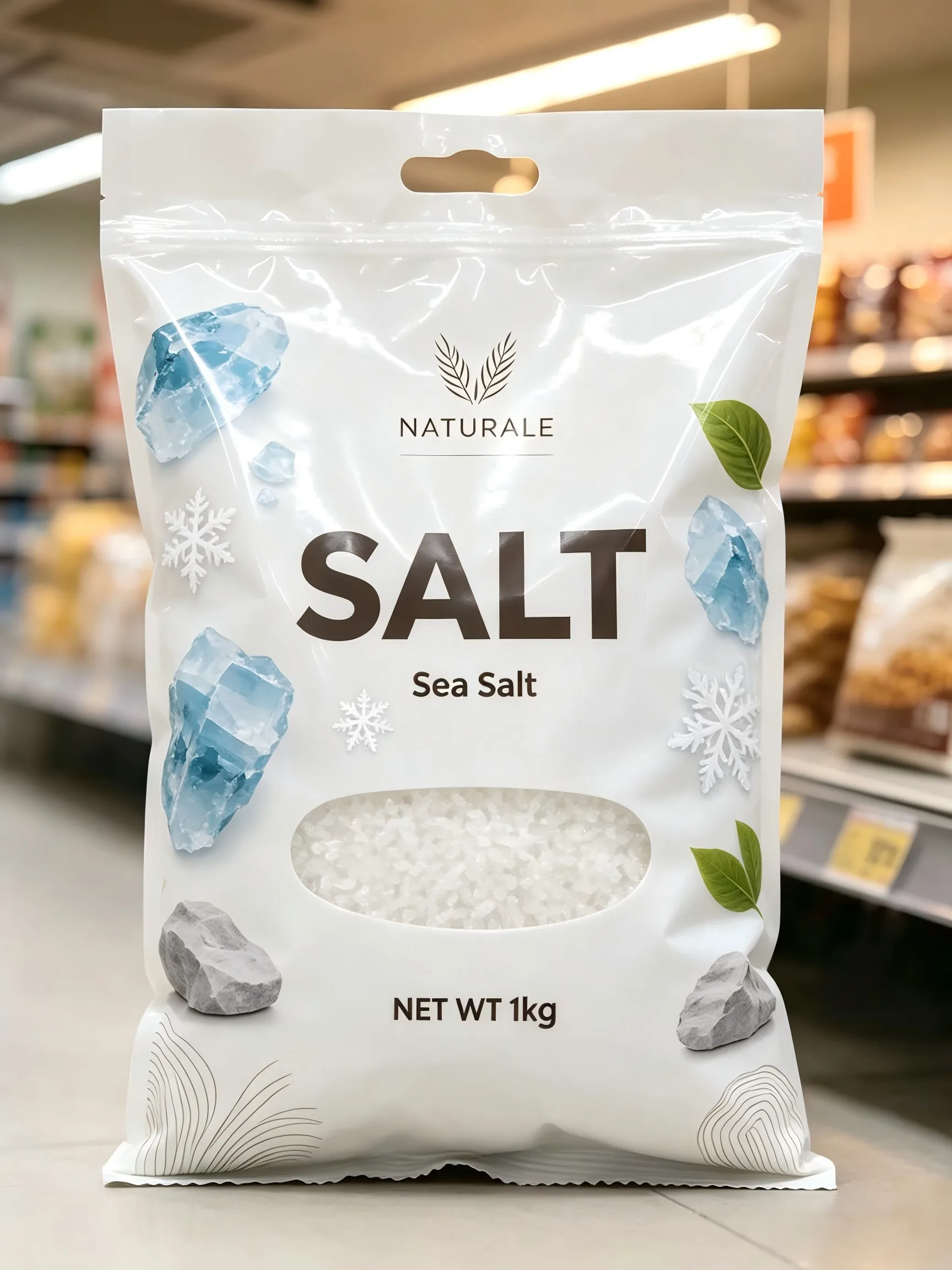
Salt is the most aggressive of the five. It is hygroscopic, highly abrasive when crystalline, and corrosive to metal closures and to some machinery in the filling area.
Three consequences for the bag specification:
- Corrosion-resistant closures. Avoid metal components unless they are specified for salt duty.
- Stronger seam construction. Salt crystals abrade seams during handling and stacking.
- High moisture barrier for retail. For food-grade salt sold to consumers — including sea salt and flake salt — a sealed film pouch with a good moisture barrier is generally the right answer, rather than a woven sack.
Feed bags
Feed is not one product. Pelleted feed, meal, and high-fat or molassed feeds each behave differently:
- Pellets abrade the bag from the inside and generate fines that escape through seams.
- High-fat and molassed feed introduces an oxidation and rancidity dimension — the bag now has to manage oxygen, not just moisture.
- Meal feed is a dust problem before anything else.
Because feed is usually packed at 25 kg and above and stacked high, the specification usually starts with seam and compression strength, then adds a liner or lamination only where the fat content or the destination climate demands it.
Seed bags
Seed packaging has one requirement the others do not: the product has to still germinate. That changes the priorities:
- Vapour control over vapour barrier. Seed needs to stay at a stable, low moisture content; sealing in moisture is worse than letting it equilibrate.
- No chemical migration. Packaging for treated or certified seed must not interact with the treatment, and the bag's own materials have to be appropriate for the seed lot's certification requirements.
- Clear labelling real estate. Variety, lot, germination data and treatment status are usually legal requirements on the face of the bag, so print layout is a specification input, not an afterthought.
For untreated retail seed sold in small packs, film pouches with a food-grade structure are the standard answer.
Managing caking, dust and seals
| Failure | Usual cause | What to change |
|---|---|---|
| Caking / clumping | Moisture ingress through weave or closure | Add lamination, or switch to a sealed film structure |
| Dust escaping | Fine particles passing the closure | Better closure type, tighter fill tolerance, dust extraction at filling |
| Leaking seams | Product in the seal area | Change fill method, add a clean seal zone, or use a wider seal band |
| Blocked / solidified salt | Ambient humidity during storage | Higher moisture barrier, sealed pouch |
| Rancid feed | Oxygen, or high fat content | Oxygen barrier layer, shorter shelf-life spec |
The last row of that table is the one most often missed: a leak that passes a lab test and fails in the pallet is almost always a sealing-process problem, not a film problem.
Fill weight and format: a starting point
| Fill weight | Typical format | What to watch |
|---|---|---|
| 500 g – 2 kg | Stand up pouch / printed film pouch | Moisture barrier, resealable closure, dust-tight seal |
| 2 – 5 kg | Flat bottom bag / multiwall paper | Load carrying, print area for lot data |
| 10 – 25 kg | Laminated woven sack | Lamination coverage, seal or stitch integrity |
| 25 – 50 kg | Heavy woven sack, laminated as needed | Compression strength, closure abrasion resistance |
Dense products such as sugar and salt need smaller bag dimensions for the same weight than flour and feed. Fill a sample at the real fill weight before printing.
Frequently asked questions
Are paper bags or PP woven bags better for flour?
Paper for small retail weights, where print quality and a traditional look matter and loads are light. Woven PP, laminated, for anything heavier or for humid destinations, because paper does not carry load well and lets moisture through. Many brands use both across their range.
Why does my salt packaging corrode?
Salt is hygroscopic and corrosive. If the closure or machinery has metal components not specified for salt duty, they will corrode. Switch to corrosion-resistant components and increase the moisture barrier.
Can I use one bag for feed and seed?
Not if the seed is certified or treated. Feed and seed have different contamination, labelling and vapour-control requirements, and the seed lot's certification usually constrains the packaging you are allowed to use.
What is your minimum order and lead time?
One piece, with a seven-day production window and DDP shipping worldwide. That means you can request a single sample, fill it with your real product, and test caking, dust and seal behaviour before committing to volume. Send us your specification and we will quote against it, or browse the full format range.
---