
Exporting charcoal is no longer just a packaging question
If you sell charcoal domestically, your bag decision is mostly a product decision. If you export it, the same bag is now part of a compliance chain.
Ocean carriers have moved to treat charcoal shipments as dangerous goods, requiring declaration and specific handling. At the time of writing this is being applied through the IMDG framework, and the practical details are set by your carrier and destination country.
I am not going to give you a legal reading of the rules — that is your freight forwarder's job. What I can do is list the packaging consequences, because they change what you should print on the bag and how you should pack a pallet.
Treat every statement below as a starting point to verify with your forwarder before you ship.
What the change means for your bag spec
Three things follow from charcoal being declared as dangerous goods:
- The bag becomes part of a declared package. The outer packaging has to be intact and identifiable, not merely attractive.
- Product temperature at packing matters. Carriers commonly impose a maximum temperature and a minimum weathering period before charcoal can be packed, precisely because self-heating is the concern. Industry guidance in circulation references weathering of at least two weeks and a packing temperature ceiling — confirm your carrier's actual figures.
- Your pallet configuration matters too. Ventilation, stacking height and wrap choice all affect whether a pallet behaves as declared.
None of this is exotic. But it does mean a bag that was fine for domestic retail may need review before the first export container.
Labelling: what has to be on the bag
Exact requirements vary by destination, but a compliant charcoal bag usually has to carry, at minimum:
- the declared product name and net weight
- the producer or exporter identity
- the lot or batch reference
- the dangerous goods information your forwarder specifies for that shipment
- country-of-origin marking where the destination requires it
If you are printing bags before the first shipment, leave room. Changing a plate after the fact is far more expensive than allowing a blank panel for the compliance block.
Retail formats for charcoal
Block bottom bags with handles
The workhorse for 5–20 kg retail and export. The flat base lets the bag stand on a pallet and on a shop floor, and the handle makes a heavy fill liftable. Load-rate the handle for the fill weight — this is where most retail failures happen.
Kraft-front and paper-look bags
Popular where the brand wants a natural or eco signal. Usually built as a kraft outer with a film or liner inner for moisture resistance, so the look is paper while the function is film.
See our flat bottom bag range for block bottom options.
Box pouches and stand-up pouches
For 1–5 kg retail. Good shelf presence and easy pouring. Our stand up pouch range covers these formats.
Bulk woven bags
For 15–25 kg and for export pallets, a woven PP outer with a PE liner is still the most cost-effective route. The liner does the moisture work; the woven layer carries the load.
Instant-light charcoal: an extra set of rules
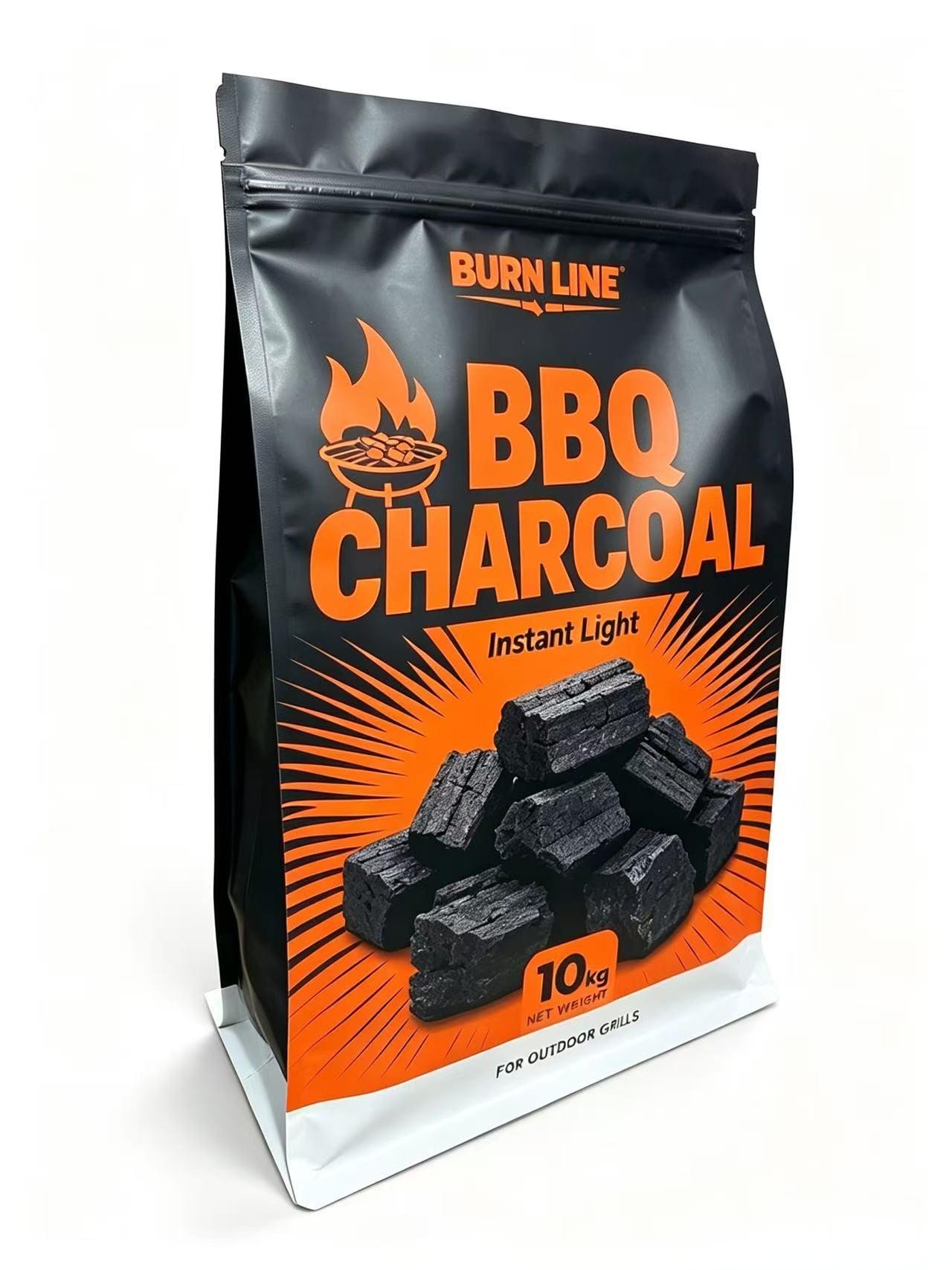
Instant-light or ready-to-light charcoal is impregnated with a liquid accelerant. That single fact changes almost everything about how it is packed and shipped.
- It is generally treated as a flammable solid or flammable liquid depending on the formulation, rather than as plain charcoal — so the dangerous goods class is different, not merely "more of the same".
- The accelerant can attack the packaging from the inside. Films, adhesives and inks that are fine for plain charcoal may soften, bloom or delaminate.
- Some destinations and some transport modes restrict it outright. Air freight in particular is usually closed to it.
If you are packing instant-light, tell your converter what the accelerant is and expect to test a real filled bag over time, not just a print sample.
Fill weights and which format carries them
| Fill weight | Format | Export note |
|---|---|---|
| 1–3 kg | Stand up or flat pouch | Retail shelves, air-unfriendly if instant-light |
| 5 kg | Block bottom with handle | Strongest retail-and-export overlap |
| 10 kg | Block bottom, kraft-front bag | The most common export SKU |
| 15–25 kg | Woven PP with PE liner | Cheapest per kilo, weakest shelf presence |
What DDP changes
If your supplier ships DDP — delivered duty paid — the freight, duty and final-mile leg are handled for you. For charcoal that matters more than for most products, because the dangerous-goods declaration and documentation sit with the shipper.
Practically it means you should expect your packaging and freight conversations to be connected. A bag spec that ignores how the pallet is declared will cost you time at the port.
Frequently asked questions
Can you print the dangerous goods markings on the bag for me?
We print the artwork you supply, including compliance blocks. The content of those markings has to come from you and your forwarder — we do not certify regulatory text.
What fill weight should I start with for export?
10 kg is the most common charcoal export SKU, with 15–25 kg woven sacks for bulk. Your destination and pallet configuration will usually decide it.
Do you make instant-light charcoal bags?
We produce flexible packaging for charcoal in retail and bulk formats. If the fill is instant-light, tell us the accelerant up front so the film structure and inks can be selected for it. Minimum order is 1 piece, production runs in 7 days, shipped DDP worldwide.
Where can I read about barrier and thickness decisions?
Our guide to mylar bag thickness explains what mil ratings do and do not buy you — the same logic applies to charcoal film.
For other bulk fills, see our guides on grain and cereal bags and flour, sugar, feed and seed bags.