
Why charcoal is an unusual packaging problem
Charcoal looks like a simple dry good. In practice it is dense, abrasive, dusty and heavy — four properties that each attack a different part of the bag.
It is also one of the few products where the packaging has to perform while the contents are still slightly warm, and where a pinprick leak becomes visible black dust on a pallet of white-labelled goods. That is why charcoal bags are usually specified by people who have already had one fail.
Four failure modes worth designing against
Abrasion and pinholes
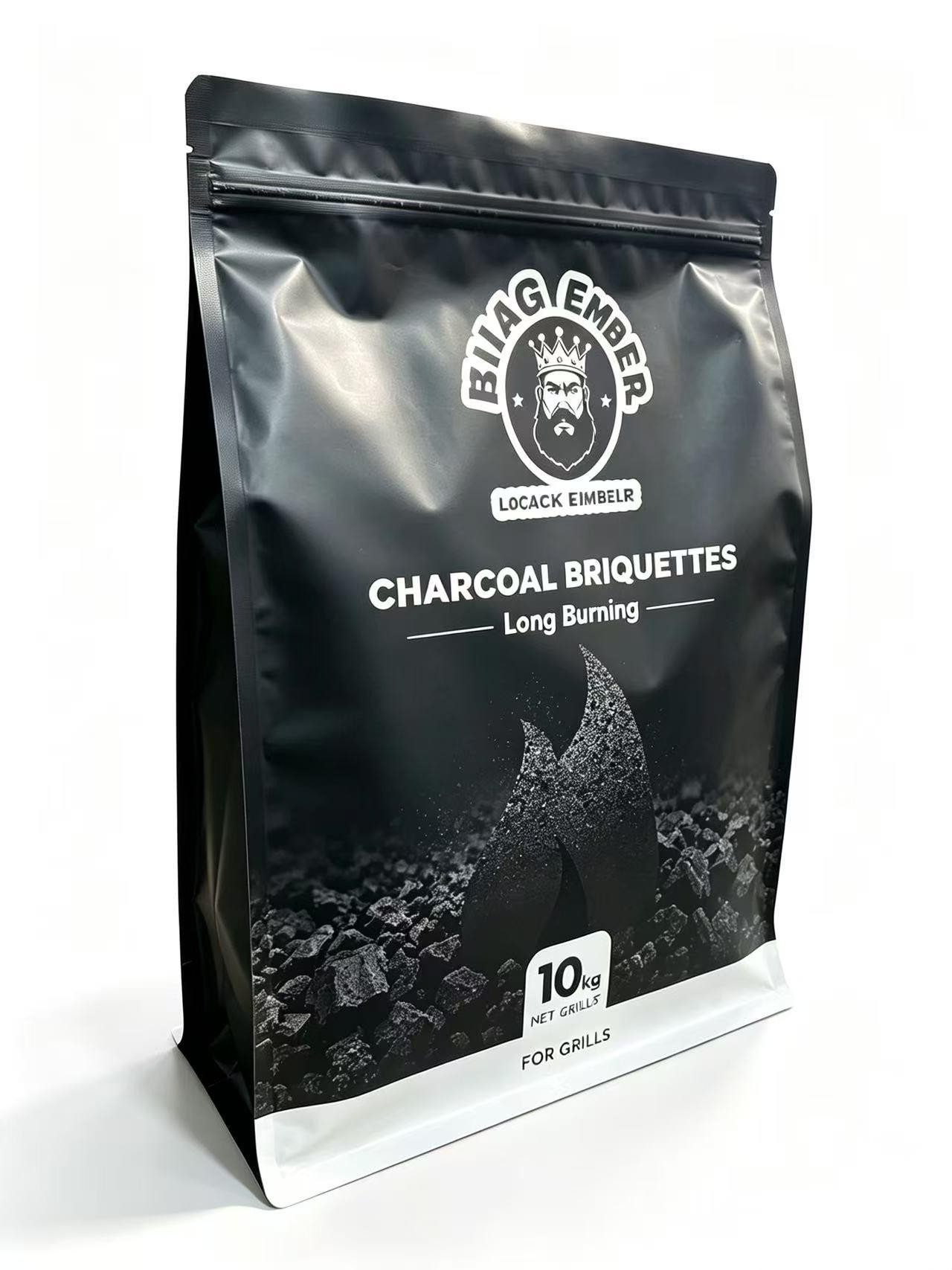
Charcoal edges are hard and angular. Under vibration in transit the contents grind against the inside of the film, and low-gauge material abrades through at the corners and along the base fold.
The fix is not simply "more thickness". It is the right combination of a puncture-resistant outer layer and enough film thickness at the points that rub, which are usually the base gusset and the top seal area.
Fines and dust at the seal
Every bag of charcoal contains some fines. During filling and handling they migrate downward, and they collect in the seal area.
A seal made across a layer of charcoal dust is a weak seal. It often passes a bench check and then fails on a pallet under stack pressure.
Two practical controls: fill with a dust-managed product, and use a seal profile that tolerates contamination — wider seal bars, and an inner liner that keeps fines away from the outer seal where possible.
Seam and handle failure at 10–20 kg
Charcoal is sold in heavy fills. A 10 kg bag has to survive being dropped, dragged and lifted by one handle or one corner.
Most of the burst failures I see on charcoal are not film failures — they are seam or handle-attachment failures. Where a carry handle is punched or welded, the load concentrates at two small points.
If a bag is going to be lifted by a handle, the handle has to be load-rated for the fill weight, not merely present.
Moisture — the slow one
Charcoal is hygroscopic. Absorbed moisture costs you ignition performance, and it is invisible until the customer lights the bag.
A fully sealed film bag sounds like the safe answer, but if the product is packed warm or in a humid climate, sealing it in can trap that moisture inside rather than keep it out. This is the same barrier-versus-breathability trade-off that affects grain and other bulk products.
The usual compromise is a moisture-resistant construction that keeps external humidity out without sealing in residual moisture from the packing line.
Cool and cure before you pack
This is the step most brands skip, and it is not a packaging decision at all.
Briquettes and lump come off the kiln or press hot. Packed too early, they release moisture and volatiles inside the bag, and a sealed pack can then be warm and humid in the middle while looking perfect from outside.
Industry practice is to let the product cool fully before packing, and carriers commonly impose a maximum product temperature at packing. The specific number is set by your carrier and destination — confirm it with them rather than assuming, because it is now tied to dangerous goods rules as well.
Structures that hold up
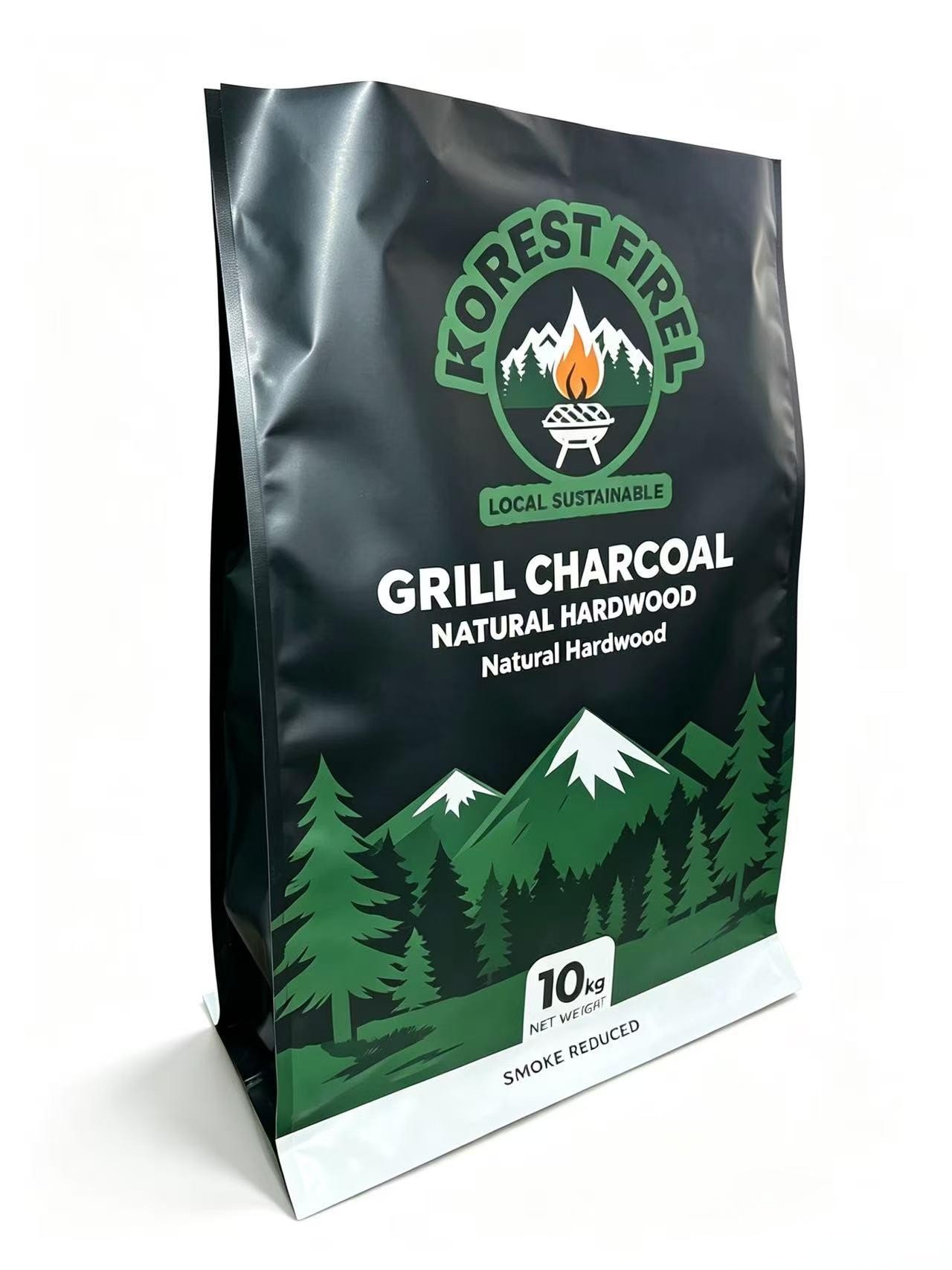
A few constructions do most of the work in this category:
- Woven PP with a PE inner liner — the standard for bulk and export weights. The liner is what keeps moisture out; the woven outer carries the load.
- Laminated woven bags — add a printed outer surface for retail-branded bulk. The lamination also stops fines escaping through the weave.
- Multilayer kraft — popular for a natural look and for retail, usually with a film or liner layer for moisture.
- BOPP-laminated film — for retail pouches where shelf presentation matters as much as protection.
For retail formats — block bottoms with handles, box pouches, stand-up pouches — see our flat bottom bag and stand up pouch ranges.
Fill weights and formats: a starting point
| Fill weight | Typical format | What to watch |
|---|---|---|
| 1–3 kg | Retail pouch, flat sachet, small block bottom | Shelf presentation, easy pour |
| 5 kg | Block bottom with handle | Handle load rating |
| 10 kg | Block bottom with handle, kraft-front bag | Base gusset abrasion, seam strength |
| 15–20 kg | Woven PP with liner, heavy block bottom | Top seam, corner drop performance |
Dimensions differ by product density and by how much fines content your charcoal carries, so treat this as a starting point for discussion, not a specification.
If you are also packing other bulk goods, our guides on grain and cereal packaging and flour, feed and seed bags cover the same load-versus-barrier trade-offs in different products.
Five questions to settle before you print
- What fill weight, and will the bag ever be lifted by a handle?
- How much fines content does the product carry, and how is it screened?
- What is the maximum product temperature at the time of packing?
- How long will a pallet sit in a humid or cold environment before it is opened?
- Does the bag need to survive being dropped on a corner from pallet height?
Get those five answered and the structure usually picks itself.
Frequently asked questions
Is a thicker bag always better for charcoal?
No. Thickness helps against abrasion, but the failures we see most often are seals and handle attachments, which thickness alone will not fix. Splitting the gauge between the outer layer and the seal area matters more than adding film everywhere.
Can I pack charcoal in a fully sealed film pouch?
You can, but think about residual moisture. If the product is not fully cooled and dried, a sealed pouch can hold that moisture in. Test with a real fill before committing to a print run.
Why do my bags leak black dust?
Almost always a seal made over fines. Check the fill line for dust control, then look at seal width and seal pressure. Our FAQ page covers sealing basics.
Do you print retail charcoal bags?
We produce custom printed flexible packaging for charcoal in retail and bulk formats — from 1 piece minimum, produced in 7 days, shipped DDP worldwide. That means you can hold a finished bag, filled with your own product, before you commit to volume.